
Distribution ERP Solutions for Growing Australian Businesses
Built for distributors who want clearer margins, faster fulfilment, and systems that scale with growth.
Quick Summary
Running a distribution business is no longer just about moving stock. It’s about maintaining control as complexity increases. This means more SKUs, more suppliers, more warehouses, more customer expectations, and tighter margins.
AlphaBiz helps Australian distribution, wholesale, and logistics businesses regain control by implementing enterprise-grade ERP systems that connect inventory, warehouse, finance, sales, payroll, and reporting into one reliable operating platform.

Margin
Control

Fulfilment Accuracy

Scalable
Operations
Table of Contents
- The real challenges facing distribution businesses
- Why systems matter more as you scale
- How AlphaBiz supports distribution & warehouse operations
- Inventory, warehouse & supply chain control
- Finance, payroll & workforce alignment
- Business intelligence for better decisions
- What makes AlphaBiz different
- What implementation really involves
- Signs it’s time to upgrade
- Frequently Asked Questions
- Book a distribution systems assessment
The Real Challenges Facing Distribution Businesses
Most distribution businesses don’t struggle because of lack of demand. They struggle because growth exposes weaknesses in their systems.
- Inventory becomes unreliable
- Warehouses feel constantly under pressure
- Finance and operations stop lining up
- Reporting arrives too late to guide real decisions
At this stage, leadership is no longer managing a business. They are managing problems. And the cost of staying where you are becomes higher than the cost of change.
Why Systems Matter More as You Scale
Growth does not create problems. Growth reveals them.
High-performing distributors operate with a fundamentally different structure. They don’t rely on people holding the business together. They rely on systems that give them live visibility, predictable workflows, and accurate financial truth.
- They understand which products drive profit
- They see problems early
- They expand without operational chaos
Their advantage is not working harder. It is working with better structure.
How AlphaBiz Supports Distribution & Warehouse Operations
AlphaBiz is a specialist implementation partner for MYOB Acumatica, an enterprise cloud ERP designed for complex, operational businesses. But our real role is not technical. It is strategic.
We don’t sell software. We design operating systems for growing distribution businesses.
We help leadership teams translate business goals into operational reality by designing systems that unify inventory, purchasing, warehousing, finance, sales, payroll, and reporting into one connected environment.
Instead of managing around the system, your business finally runs on it.

Inventory, Warehouse & Supply Chain Control
This is where most clients feel the first shift.
Inventory becomes accurate and visible in real time across all locations. Picking, packing, and dispatch become predictable instead of reactive. Purchasing moves from guesswork to demand-driven planning. Supply chains stabilise, and margins stop leaking through inefficiencies no one could previously see.
When operations settle, leadership can finally step out of the weeds.

Finance, Payroll & Workforce Alignment
When finance, warehouse, and people systems operate separately, leadership loses clarity.
When those systems are disconnected, leadership loses trust in the numbers, teams work around the tools, and decisions get delayed.
With AlphaBiz:
- Financials reflect real operations
- Payroll and workforce processes align with how teams actually work
- Management gains clear visibility of margins by product, customer, and channel
What changes most is not the software. It’s the confidence behind every decision.

Business Intelligence for Better Decisions
Most growing distribution businesses are rich in data and poor in insight.
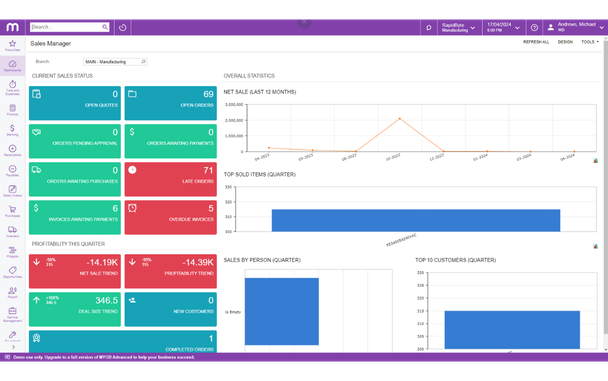
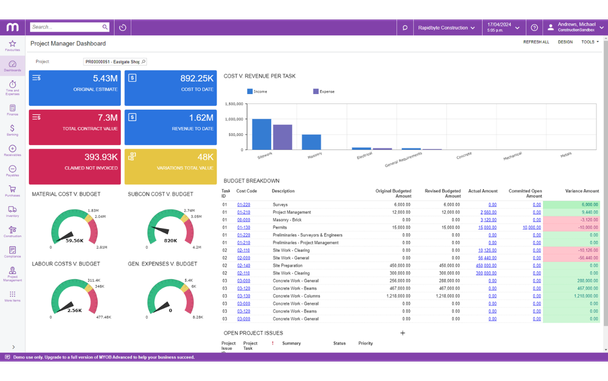
By integrating advanced business intelligence tools, AlphaBiz turns daily operations into live dashboards that show performance as it happens, allowing leaders to act before problems grow expensive.
Downloadable Guide: Tech Transformation in Wholesale Distribution
Wholesale distribution is changing fast. Customer expectations, supply chain pressure, and margin constraints are forcing distributors to rethink how they operate.
This guide explains what’s driving the shift, where legacy systems fall short, and how modern ERP helps distributors regain control and stay competitive.

What Implementation Really Involves
Transformation doesn’t happen by installing software. Technology alone does not transform businesses.
Transformation happens when systems are designed around real processes, implemented with structure, and adopted by people who understand why change matters.
AlphaBiz follows a proven methodology that reduces risk, accelerates adoption, and ensures the platform evolves as the business grows.

Signs It’s Time to Upgrade
Most distribution leaders recognise the moment:
- Inventory accuracy declines
- Orders increase but profit does not
- Reporting stays slow and manual
- Leadership lacks real-time visibility
These are signs that your operational complexity has outgrown the systems supporting it. A connected ERP can bring inventory, orders, warehouses and financial information back into one operating environment.

Frequently Asked Questions About ERP for Wholesale & Distribution Businesses
Get answers to common questions about wholesale distribution ERP software, including inventory management, warehouse operations, order fulfilment, purchasing, multi-location stock and implementing MYOB Acumatica for growing Australian distribution businesses.
What is wholesale distribution ERP software?
Wholesale distribution ERP software connects inventory, purchasing, sales orders, warehouse operations, finance and reporting within one business system.
For distributors and wholesalers, this creates a shared source of information across sales, warehouse, purchasing and finance teams. Instead of relying on separate systems and spreadsheets, businesses can track stock, orders, purchasing activity and financial performance from a connected platform.
MYOB Acumatica is a cloud ERP platform that supports wholesale distribution businesses with inventory management, sales and purchase order management, warehouse operations, financial management and reporting.
Is MYOB Acumatica suitable for wholesale and distribution businesses in Australia?
Yes. MYOB Acumatica can suit Australian wholesale and distribution businesses that need greater control over inventory, warehouses, orders, purchasing and financial information.
It is particularly relevant when a business has outgrown basic accounting software or relies on separate systems for stock, sales, warehouse and finance processes.
The right ERP setup depends on factors such as your number of products, warehouses, sales channels, transaction volumes, purchasing workflows and existing systems. AlphaBiz reviews these requirements before configuring MYOB Acumatica around the way your distribution business operates.
How does MYOB Acumatica improve inventory management for distributors?
MYOB Acumatica gives distributors greater visibility over inventory across warehouses and locations while connecting stock information with purchasing, sales orders and financial processes.
Businesses can manage inventory locations, replenishment, product information and stock movements within the same ERP environment. This helps purchasing, warehouse and sales teams work from more consistent inventory information.
Better stock visibility can also help distributors identify shortages earlier, improve replenishment decisions and reduce dependence on spreadsheets or manual stock checks when planning purchases and fulfilling customer orders.
Can MYOB Acumatica manage inventory across multiple warehouses and locations?
Yes. MYOB Acumatica supports inventory management across multiple warehouses and locations.
Inventory can be organised by warehouse and more detailed storage locations such as aisles, racks, shelves and bins. This gives distribution businesses a clearer view of where stock is held and helps warehouse teams manage inventory as operations become more complex.
For businesses expanding into additional warehouses or distribution centres, a connected ERP also allows authorised teams to work from shared inventory, order and financial information rather than maintaining separate systems at each location.
Does MYOB Acumatica support automated inventory replenishment?
Yes. MYOB Acumatica includes inventory replenishment capabilities that can help distributors plan when additional stock needs to be purchased or transferred.
Replenishment processes use inventory and demand information to support purchasing decisions instead of relying only on manual checks or individual staff knowledge.
For wholesale businesses managing large product ranges, this can help purchasing teams maintain appropriate stock levels while reducing the risk of shortages or unnecessary excess inventory.
Replenishment rules should be configured around factors such as supplier lead times, demand patterns, stock policies and warehouse requirements.
Can MYOB Acumatica manage sales orders and order fulfilment?
Yes. MYOB Acumatica includes sales order management capabilities for distributors handling orders across different customers and sales channels.
Businesses can manage sales orders, returns, exchanges, pricing and discounts while connecting order information with inventory and financial processes.
Because sales and stock information are connected, teams have better visibility into product availability while processing orders. This can help reduce manual data entry and improve coordination between sales, warehouse and finance teams throughout the order fulfilment process.
Can MYOB Acumatica improve warehouse picking, packing and shipping?
Yes. MYOB Acumatica provides warehouse management capabilities that can support picking, packing and shipping processes.
Warehouse teams can use functions such as mobile scanning and wave or batch pick lists to help organise fulfilment activity. Shipping information can also be connected with wider order and inventory processes.
For growing distribution businesses, this reduces reliance on paper-based warehouse processes and disconnected information. The exact warehouse configuration should be designed around your order volumes, warehouse layout, picking methods and fulfilment requirements.
Can MYOB Acumatica track lot numbers, serial numbers and product shelf life?
Yes. MYOB Acumatica supports inventory traceability using lot and serial attributes, including shelf-life information.
This is useful for distributors that need to identify specific batches or individual products as stock moves through purchasing, inventory and fulfilment processes.
Traceability requirements vary significantly between industries, so businesses should define what information needs to be captured and retained during ERP implementation. AlphaBiz can assess these requirements and configure the inventory structure around the products and processes your distribution business manages.
Can MYOB Acumatica connect wholesale distribution with e-commerce sales?
MYOB Acumatica can integrate e-commerce platforms with sales and fulfilment processes, helping distributors connect online sales channels with inventory and order information.
This can reduce manual re-entry of online orders and give teams greater visibility over how e-commerce activity affects stock and fulfilment.
The appropriate setup depends on the e-commerce platform, the information that needs to move between systems and the required workflow. AlphaBiz can assess your existing sales channels and determine whether an available integration or tailored connection is required.
Can MYOB Acumatica help distributors manage purchasing and suppliers?
Yes. MYOB Acumatica includes purchase order and procurement capabilities that help distribution businesses manage purchasing alongside inventory and financial processes.
Businesses can use purchasing information with stock requirements and sales demand to make more informed procurement decisions. Purchase orders and received goods can also be connected with wider accounting processes.
For distributors managing multiple suppliers and large product ranges, connecting purchasing with inventory gives teams a clearer view of what is being ordered, what has been received and how procurement activity affects stock availability.
Can MYOB Acumatica show which products, locations or business units are most profitable?
Yes. MYOB Acumatica combines operational and financial information so distribution businesses can analyse performance across areas such as products, locations and business units.
This helps management move beyond basic sales reporting and understand how different parts of the business contribute to overall performance.
AlphaBiz can also connect ERP data with business intelligence and reporting tools where deeper dashboards or management reporting are required. The reporting structure should be designed around the measures that matter most to your business, such as margin, inventory performance, customer activity or warehouse operations.
Does a distribution business need to replace all its existing software when moving to ERP?
No. Moving to ERP does not automatically mean every existing business system needs to be replaced at the same time.
Some platforms may continue to serve a specialised purpose while MYOB Acumatica becomes the central ERP for areas such as finance, inventory, purchasing, warehouse operations and order management.
During discovery, AlphaBiz reviews the existing technology environment and identifies which systems should be replaced, retained or integrated. This creates a more practical implementation plan and avoids replacing useful systems simply for the sake of moving to a new ERP platform.
How long does a wholesale distribution ERP implementation take?
The implementation timeframe depends on the size and complexity of the distribution business.
Factors include the number of warehouses and users, inventory structure, transaction volumes, sales channels, integrations, reporting requirements, data migration and the amount of process configuration required.
A distributor with straightforward inventory and accounting requirements will generally require less implementation work than a multi-site business with complex warehouse operations, integrations and high transaction volumes.
AlphaBiz starts with discovery and process review before confirming the implementation scope and timeline.
How do we know when our distribution business has outgrown its current accounting system?
A distribution business should consider ERP when its existing systems no longer provide reliable control or visibility as operations grow.
Common signs include inaccurate inventory, increasing spreadsheet use, duplicated data entry, slow reporting, difficulty managing multiple warehouses, disconnected sales and finance information, fulfilment problems and limited visibility into margins.
The issue is not simply the number of employees or revenue. ERP becomes more relevant when operational complexity makes it difficult for teams to manage inventory, orders, purchasing and financial information using disconnected tools.
Who can implement MYOB Acumatica for wholesale distribution businesses in Australia?
AlphaBiz Solutions implements and supports MYOB Acumatica for wholesale, distribution and logistics businesses in Australia.
The process begins by reviewing how inventory, purchasing, sales orders, warehousing, finance and reporting currently operate. AlphaBiz then designs the ERP structure around those requirements and manages areas such as configuration, data migration, integrations, testing, training and go-live support.
For distribution businesses, this process helps ensure the ERP reflects real warehouse and operational workflows rather than simply replacing an accounting system with another piece of software.
Book a Distribution Systems Assessment
If your distribution business is ready to regain control, protect margins, and scale with confidence, speak with AlphaBiz. Request a Distribution Systems Assessment and let our team evaluate your current environment, identify constraints, and map a clear path forward.
